Copia Journal · By Cyrus Ameri, founder of Copia · · 4 min read
The ideal creative stack for any growing ad account
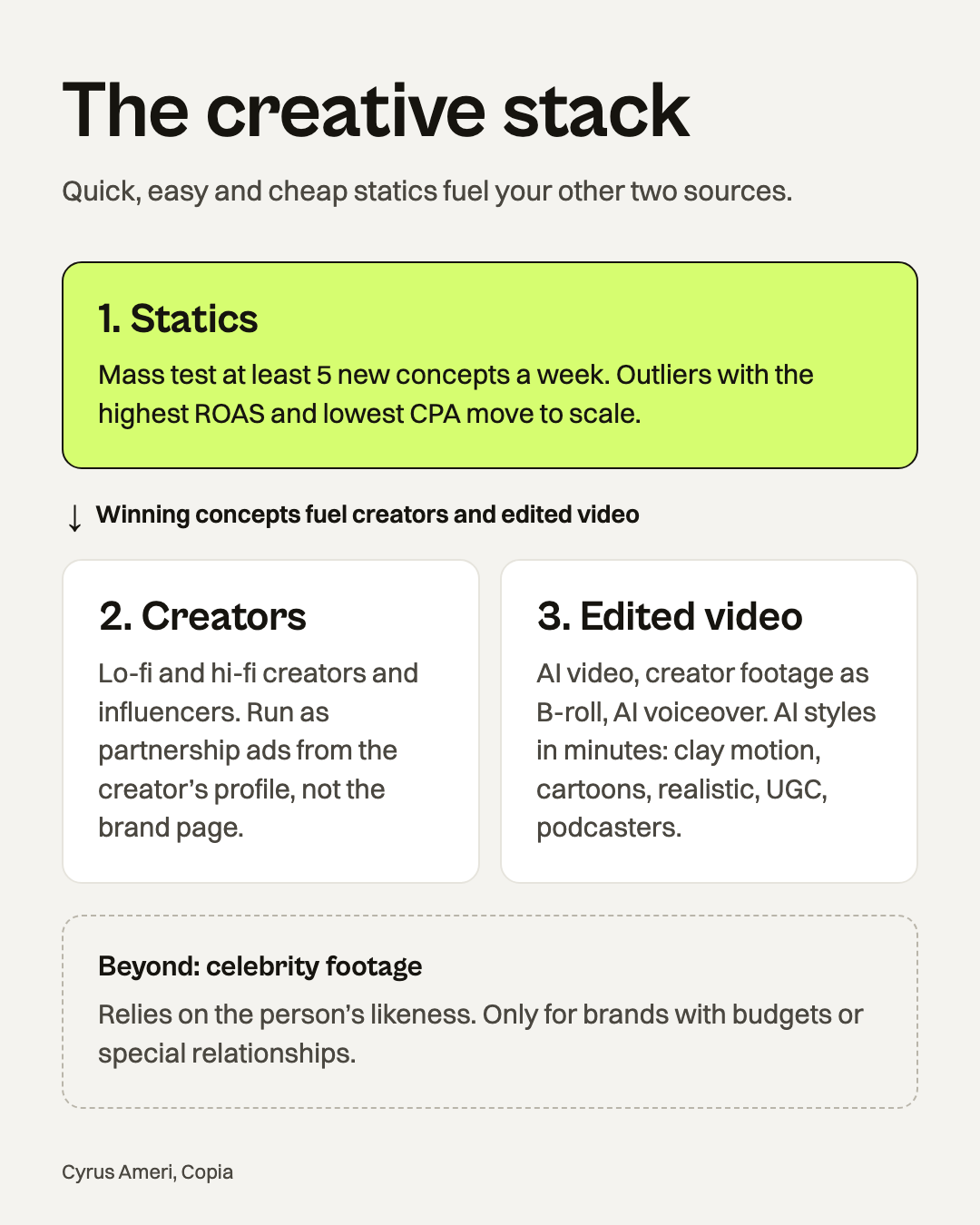
Use quick, easy and cheap static testing to find your winning concepts. Then use those winners to fuel your other two sources: creators and edited videos.
The short answer
- A growing ad account needs three sources of creative: statics, creators and edited videos.
- Statics are for mass testing. Test at least 5 new static concepts a week.
- Winning concepts from your statics fuel the other two sources.
- Run creator ads from the creator's profile, not your brand page.
Statics find your winning concepts
The ideal creative stack starts with a rotation of statics. They're quick, easy and cheap to make, so they're where you mass test all your different concepts.
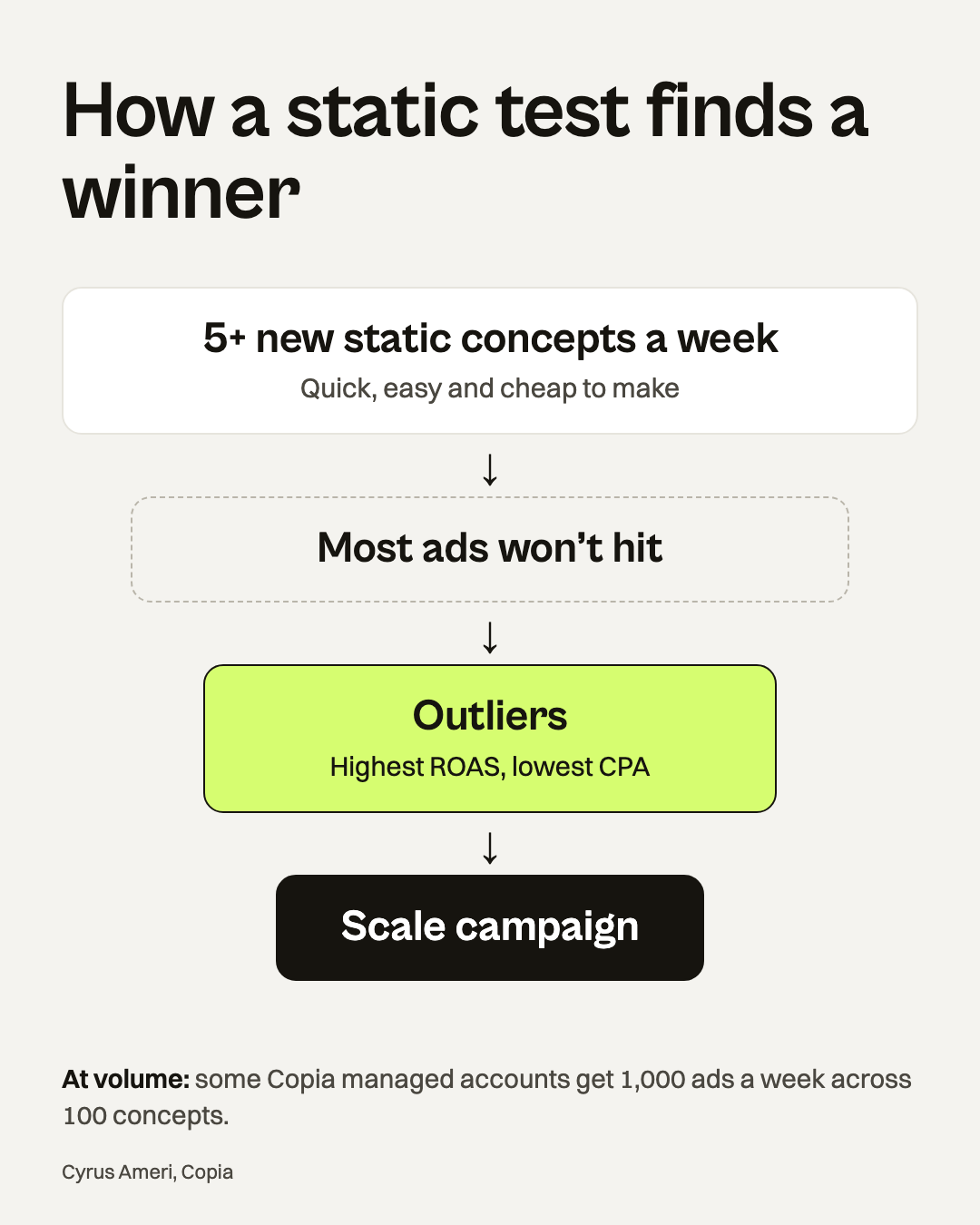
A growing account should test a minimum of 5 static concepts per week. Some Copia managed accounts get 1,000 ads a week across 100 concepts.
Most of those ads won't hit. But you will find outliers, and those can move into a scale campaign. The winners are the ads with the highest ROAS and the lowest cost per acquisition.
A winning static fuels everything else
Then the winning concepts from your static testing fuel your other two sources: human UGC and edited videos.
Smile+ is a good example. We tested lots of different messages, and the best one landed on the 16-hour gap: the 16 hours between brushing your teeth, when people need Smile+.
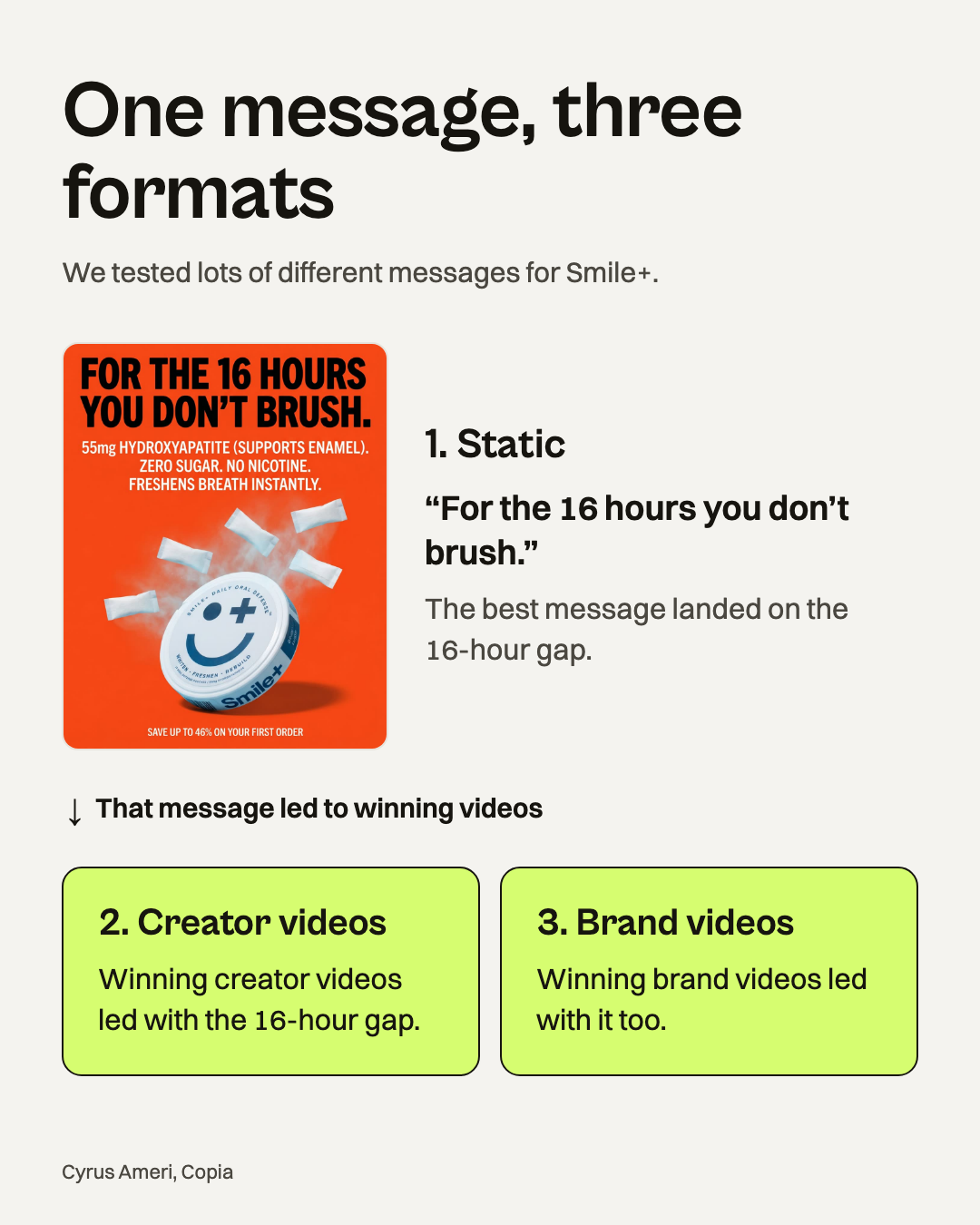
That message led to winning creator videos and brand videos that opened with the 16-hour gap.
Creators: lo-fi, hi-fi and influencers
Your second source is human UGC: lo-fi creators, hi-fi creators and influencers.
Lo-fi creators usually work on commission. Hi-fi creators get paid a monthly retainer plus commission. New brands are more likely to get lo-fi creators, and bigger brands are more likely to get hi-fi creators.
| Lo-fi creators | Hi-fi creators | |
|---|---|---|
| More likely for | New brands | Bigger brands |
| How they're paid | Commission | Monthly retainer plus commission |
This content also feeds your brand videos and more. Creator footage can be used three ways.
Use creator footage three ways
- Standalone, as its own ad.
- As B-roll in your brand videos.
- On your website.
Run creator ads from the creator's profile
This is where whitelisting comes in. Don't run creator ads from your brand profile on Facebook.
A creator ad running from the brand page builds less trust than one from an established partnership. It looks like the brand just got the video and is running it without the creator's permission.
If a creator is willing to put their profile on an ad, it builds more authenticity. Viewers also see it as an authentic, organic post rather than simply an ad.
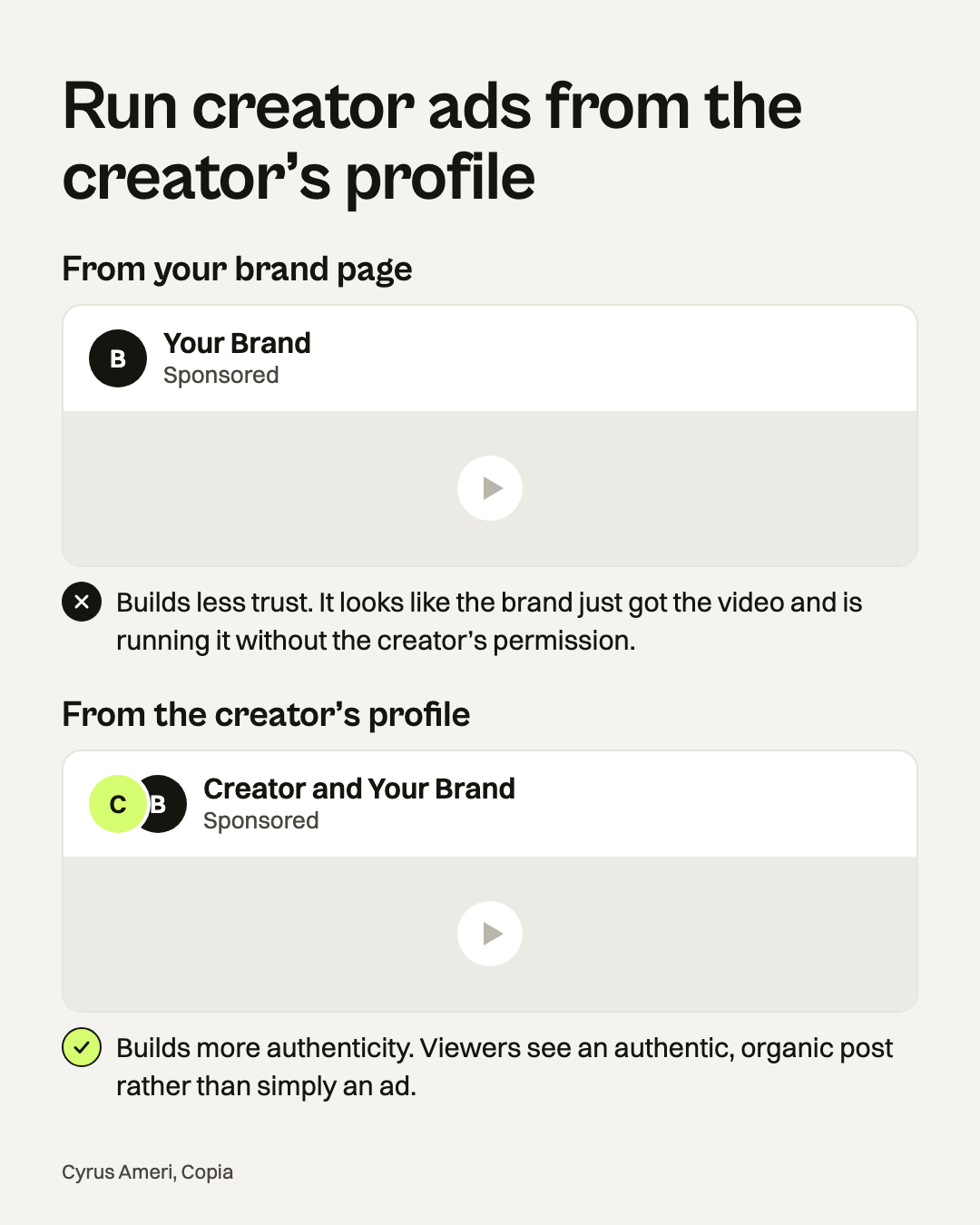
Meta calls these partnership ads. You need permission from the creator whose handle the ad will include.
Set up a partnership ad
- For an ongoing partnership, ask the creator for account-level permission.
- The creator accepts it in the Instagram app or in Meta’s Partnership Ads Hub.
- Run the ad with the creator’s handle on it, not from your brand page.
Edited and AI videos
Your third source is edited videos. That includes AI videos that are pieced together, and branded videos that take shots from your UGC and edit them with an AI voiceover. These are the quickest ways to make video ads.
Edited videos can take a couple of days to produce. AI videos can be produced in Copia in a matter of minutes.
It's best to use all the different visual styles AI video can produce: clay motion, AI cartoons, realistic, UGC, podcasters and more.



AI video styles Copia made for customers.
Beyond the stack: celebrity footage
Beyond this, there's celebrity footage, which relies on the likeness of the person. It should only be used by brands with budgets or special relationships.
The one thing to do this week
Launch at least one static ad set testing a concept you've never tested before.
Then fuel your other two sources
- Move any outlier, with the highest ROAS and lowest CPA, into a scale campaign.
- Use the winning concept to fuel your next creator videos, run from the creator’s profile.
- Turn it into edited and AI videos, with creator footage as B-roll.
Launch a concept you’ve never tested.
Paste your site. Copia researches your brand and competitors and builds your buyer personas, free. Start a plan and your first 20 ads are on us. Run it yourself from $99 a month, or hand it to a Copia strategist and design team from $2,000. Same research, same personas, same memory of what wins.
Questions
- How many static concepts should a growing ad account test each week?
- At least 5 new static concepts a week. Some Copia managed accounts get 1,000 ads a week across 100 concepts. Most ads won't hit, but the outliers with the highest ROAS and lowest cost per acquisition move into a scale campaign.
- How are lo-fi and hi-fi creators paid?
- Lo-fi creators usually work on commission. Hi-fi creators get paid a monthly retainer plus commission. Either way, their footage can be used standalone as its own ad, as B-roll in your brand videos and on your website.
- Should creator ads run from the brand page or the creator's profile?
- The creator's profile, as a partnership ad. From a brand page, a creator ad builds less trust and can look like the brand is running the video without the creator's permission. With the creator's profile on it, viewers see an authentic, organic post rather than simply an ad.
- How long does an edited or AI video ad take to make?
- Edited videos can take a couple of days. AI videos can be produced in Copia in a matter of minutes, in styles like clay motion, AI cartoons, realistic, UGC and podcasters.
- When should a brand use celebrity footage?
- Only with the budget or a special relationship. Celebrity footage relies on the likeness of the person.
Sources
- Meta Business Help Center, About partnership ad permissions, retrieved October 2026.
- Meta Business Help Center, Manage account-level permissions for partnership ads in Partnership Ads Hub, retrieved October 2026.
Published by Copia. The author is Copia’s founder. Smile+ is a Copia customer. Details on partnership ads come from Meta’s help pages listed above.